Transcript
Announcer:
You’re listening to Perspectives with the AMA on ReachMD, produced in partnership with the American Medical Association. Here’s your host, Dr. Alexandria May.
Dr. May:
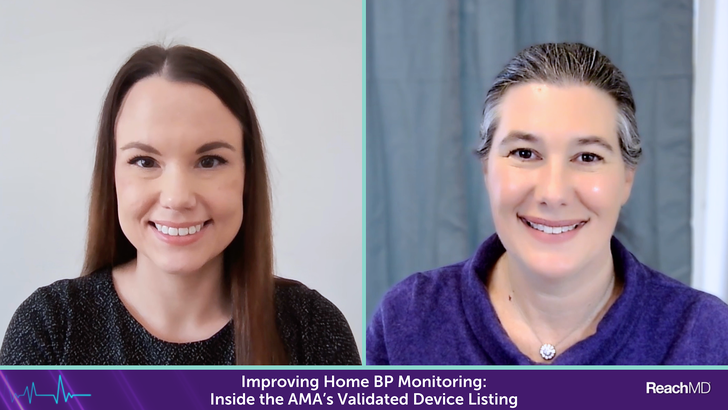
This is Perspectives with the AMA on ReachMD, and I'm Dr. Alexandria May. Joining me to share her insights on the AMA's Validated Device Listing of home blood pressure monitoring devices is Dr. Jennifer Cluett. Not only is she an Assistant Professor of Medicine at Beth Israel Deaconess Medical Center at Harvard Medical School, but she also served on the Independent Review Committee for the U.S. Blood Pressure Validated Device Listing and is a current member of the AMA’s VDL Advisory Group. Dr. Cluett, welcome to the program.
Dr. Cluett:
Thank you so much for having me. I'm excited to be here.
Dr. May:
So to start us off, Dr. Cluett, can you briefly tell us why home blood pressure monitoring is so important?
Dr. Cluett:
I consider home blood pressure monitoring to be an essential part of any blood pressure treatment plan. As it turns out, up to 30 percent of people have what we call “white coat hypertension,” which means that their blood pressure readings in the office are always going to be higher than their blood pressure readings outside of a medical setting. Beyond that, clinic readings can be influenced by things like stress, pain, anxiety, or other factors that are related to that particular medical interaction.
Both the newest multi-society hypertension guidelines that were published earlier this year by the American College of Cardiology, the American Heart Association, and the United States Preventive Services Task Force have long recommended using out-of-office measurements for blood pressure, both for the diagnosis of hypertension but also for managing hypertension and medication titration.
There's also good evidence that home monitoring can improve our patients’ blood pressure control, particularly when it's paired with feedback or team-based care. In my practice, we collaborate with team members such as clinical pharmacists or nurses. But in other settings across the country, even trusted community members like barbers or faith leaders are working with clinical teams to help our patients get their blood pressures to goal by using their home blood pressure readings and adjusting their medications as needed.
I think one of the most important things about home blood pressure monitoring is that it empowers patients. It can increase engagement. It allows them to measure their blood pressure and see the impact of how things like medication adjustments or lifestyle changes that they've been able to incorporate can impact their blood pressure readings.
Proper technique is essential 100 percent of the time. And though I'd like to tell you that blood pressures taken in a medical setting are always done 100 percent correctly, we all know that that isn't always the case. And with home monitoring, patients can really ensure that they are taking their measurements properly and consistently in the same way.
Dr. May:
And given that importance, let's zero in on the Validated Device Listing, or VDL for short. What is it, and how can it be used in clinical practice?
Dr. Cluett:
So the Validated Device Listing is a publicly accessible resource. It was created by the American Medical Association, and the purpose is to help clinicians and patients identify which home blood pressure devices have undergone proper, rigorous validation testing. As it turns out, not all devices on the market are reliable, and the VDL can provide a single, trusted resource as showing everybody which devices have met these international accuracy standards.
So I routinely recommend that both patients and my colleagues use validateBP.org when they're selecting a home blood pressure monitor or recommending a device for their patients. But it's also a valuable tool for hospitals or medical offices when they're choosing the devices that they're going to use in the office because they list home devices, kiosk devices, devices for 24-hour ambulatory monitoring, and devices meant for medical settings. So that helps ensure that the measurements that we're relying on in the medical setting are coming from devices that can be trusted.
Dr. May:
Now, how does the device make it onto the list? What does that process look like?
Dr. Cluett:
The manufacturers submit their validation testing to the AMA. And that validation testing either needs to be done by independent investigators—so people who aren't working for that manufacturer—or if they do the testing internally, it needs to be published in a peer-reviewed journal to be considered. And after it's submitted, the two different members of that independent review committee review independently on their own and evaluate whether or not the testing that's been done meets those VDL criteria.
And the criteria are based upon internationally accepted validation protocols that are specific for oscillometric or automated blood pressure cuffs. And the testing is pretty rigorous. It requires that the devices perform accurately in a wide range of patients, including those who have small or larger arms and those with low, normal, or high blood pressure readings. And so the testing really is fairly rigorous.
After those reviewers do their independent evaluation, they present their findings to the full committee, and a device can be listed on the website after the committee reaches a consensus that the evidence is complete and the device has met all of the required accuracy standards.
Dr. May:
As a follow-up to that, are most blood pressure devices validated? And if not, why hasn't that been addressed?
Dr. Cluett:
Dr. May, most devices are not validated. Up to 70 percent of the devices that are available for consumers to purchase don't have any published accuracy data at all. And to be clear, this doesn't mean that they're inaccurate; it just means that they haven't gone through this process.
One of the major reasons is that the current FDA clearance pathway does not require manufacturers to submit accuracy validation testing, and so these devices can enter the market without demonstrating that they meet these international standards for accuracy. Some companies may have never performed the validation testing; others may have done it but relied on either outdated or older validation testing or inadequate protocols.
The VDL, I think, is really helping to close this gap by creating a clear, trusted pathway and setting expectations both for manufacturers and for the consumers, but I really think we need broader industry participation and awareness about the importance of this validation testing.
Dr. May:
Absolutely. I'm loving this discussion, Dr. Cluett.
For those just tuning in, you're listening to Perspectives with the AMA on ReachMD. I'm Dr. Alexandria May, and I'm speaking with Dr. Jennifer Cluett about the importance of accurate home blood pressure monitoring and the AMA’s Validated Device Listing.
Now, if we take a look at this from a patient perspective, patients tend to like the wrist cuffs because they can be more affordable and convenient than, say, an upper-arm cuff. But are those validated and okay for patients to use?
Dr. Cluett:
So it's a great question, and it comes up all of the time in clinical practice. Some wrist cuffs are validated, but I generally only recommend them in specific circumstances. And although patients may view them as more convenient or easier to use, they're actually not typically cheaper. In fact, they can often cost more than a good upper-arm device. And since you brought up the issue of cost, I think it's important to know that you don't have to spend more money to get a more accurate device, and there's options on the VDL that are in the $30-35 price range that are every bit as accurate as the ones that cost over $100.
As it turns out, the wrist devices are much more sensitive to positioning, and even small changes in where your wrist is in relation to your heart can lead to inaccurate readings. So for patients who truly can't use an upper-arm cuff, either because of arm size, limited mobility, or discomfort, one of the validated wrist devices can be an acceptable alternative, but for most people, I typically recommend the upper-arm cuff first.
Dr. May:
With that in mind, what else is needed for a patient to get an accurate reading and for clinicians to trust those readings?
Dr. Cluett:
It's a wonderful question, and I sort of alluded to the proper technique that's so important. And it's important to recognize that even a device that's on the VDL can give inaccurate readings if it isn't used properly. And technique is so important for blood pressure measurement. Patients need to have education about the preparation and the positioning before they even start to check the measurements.
So important factors are sitting quietly for a minimum of 5 to 10 minutes before measuring their blood pressure. They should keep their back and their feet supported. I mentioned the positioning of their arms so that the cuff is roughly at heart level. It's also important to avoid things like caffeine, exercise, large meals, alcohol, tobacco use, or smoking before you measure your blood pressure because all of these things can cause variation in blood pressure readings.
It's also important to remember that a device that isn't yet on the VDL may actually still be accurate in any individual patient. It just means that we don't have verification of its accuracy yet through those rigorous protocols. So to ensure ongoing reliability, even in a device that is already listed on the VDL, I often recommend that patients bring their home monitor to the clinic about once a year so that we can compare readings and confirm that the device is still performing well for them.
Dr. May:
Those are all great points to consider. Before we close, Dr. Cluett, let's look ahead for a moment. What do you think the future of blood pressure measurement looks like?
Dr. Cluett:
We're at a really exciting time, and there is a lot of interest in wearable blood pressure devices, or what we call cuffless blood pressure devices. There are rings and watches; I've even seen a toilet seat that claims it can measure blood pressure. But I'm really cautious about the role of those devices in clinical care.
Those current guidelines that I referenced earlier recommend against using these cuffless or wearable devices for the diagnosis and management of hypertension just because their inaccuracy is still uncertain. We're expecting a dedicated validation protocol specifically for those different types of blood pressure devices in early 2026, and I think that is going to be an important step forward in helping to determine whether or not they can meet the standards needed for clinical use.
So for now, validated upper-arm devices remain my cornerstone for accurate blood pressure measurement, and any future technology that I'm going to recommend has to demonstrate the same level of rigor before I'm going to incorporate it into my clinical practice.
Dr. May:
As those forward-looking comments bring us to the end of today's program, I want to thank my guest, Dr. Jennifer Cluett, for joining me to share her insights on the critical role of home blood pressure monitoring and the AMA’s Validated Device Listing. Dr. Cluett, it was great having you on the program.
Dr. Cluett:
Thanks. It was great to be here.
Announcer:
This was Perspectives with the AMA on ReachMD, produced in partnership with the American Medical Association. To access this and other episodes in this series, visit Perspectives with the AMA on ReachMD.com, where you can Be Part of the Knowledge. Thanks for listening!